

The Honest Answer Nobody Wants to Hear
The service dog training timeline is long. Plan for 12 to 24 months of consistent, structured work before a dog is ready to handle real-world public access and reliably perform disability-mitigating tasks. Some dogs get there closer to 12 months. Many take 18. A few need the full two years.
That range is not a failure. It is the reality of building a working dog. Any program or trainer promising a fully trained service dog in six months or less should raise an immediate red flag. True task training cannot be rushed without cutting corners that will hurt you and your dog later.
This guide breaks the process down phase by phase so you know exactly what you are building toward and when to expect each milestone.
Phase One: Foundation Obedience
Typical duration: Months 1 through 4
Everything begins here. Before a dog can learn a single task, it needs a rock-solid foundation in basic obedience. Sit, down, stay, heel, come, leave it, place. These are not optional extras. They are the scaffolding every task gets built on top of.
Work these behaviors until they are automatic. Your dog should respond to a cue the first time, without hesitation, whether you are in your kitchen or standing in a crowded parking lot. That level of reliability takes months of short, daily sessions, not weeks of weekend training.
Focus on positive reinforcement-based methods. Marker training, either with a clicker or a verbal marker, gives your dog precise feedback about which behavior earned the reward. Precision matters in service dog work more than in pet dog training.
At the end of phase one, your dog should pass a basic obedience assessment equivalent to the American Kennel Club's Canine Good Citizen test. If the dog cannot consistently pass that benchmark, do not move to phase two. Skipping ahead is how handlers end up with a dog that falls apart in public six months later.
Phase Two: Public Access Preparation
Typical duration: Months 3 through 8 (overlaps with phase one)
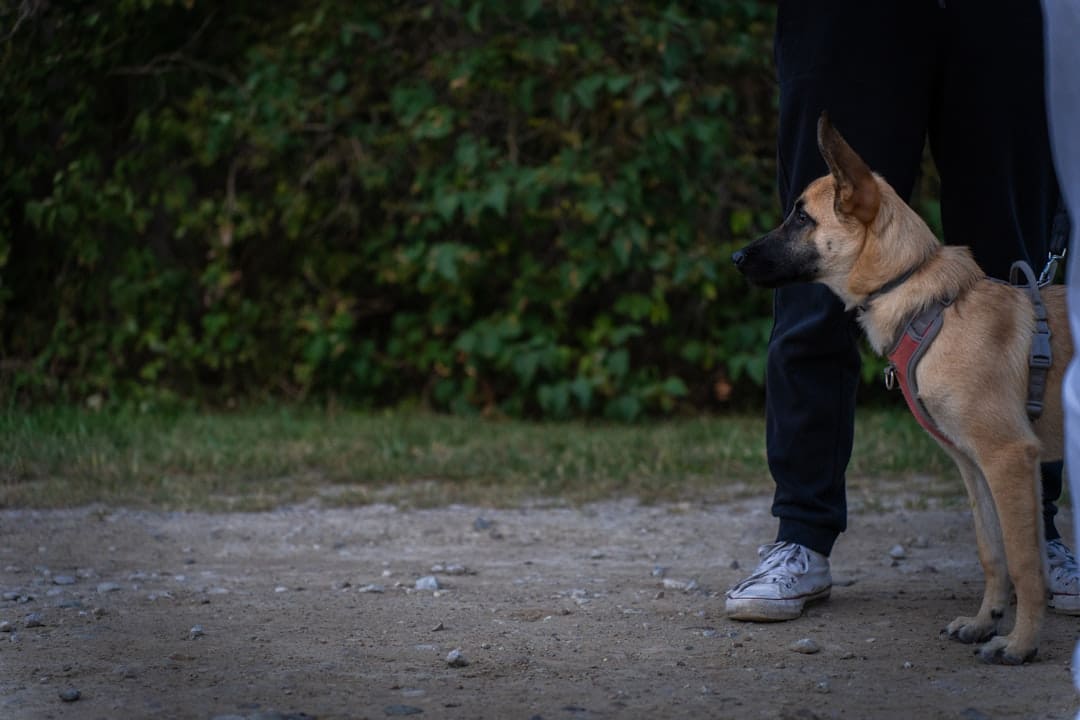
Public access training begins as an overlay during the second half of foundation work, not after it is finished. As your dog's obedience becomes reliable at home, start introducing it to more challenging environments.
Start small. A quiet parking lot. A pet-friendly hardware store on a slow Tuesday morning. A calm outdoor seating area. Expose the dog to carts, crutches, children, automatic doors, slippery floors and loud speakers. Watch carefully. Note what triggers stress or distraction. Do not push through stress. Work around it, then incrementally toward it.
The goal of this phase is a dog that can maintain a working state of calm focus in any public environment. The dog should be able to hold a position command for extended periods, ignore dropped food, ignore other dogs, and walk calmly on a loose leash regardless of what is happening around it.
Handlers who skip or rush public access prep produce dogs that can perform tasks beautifully at home but fall apart at the grocery store. Public access is its own training discipline. Treat it that way.
Under the Americans with Disabilities Act, a service dog must be under control at all times in public spaces. A dog that lunges, barks repeatedly or eliminates in a public space can be asked to leave, regardless of the tasks it knows. Public access reliability is not optional.
Phase Three: Task-Specific Training
Typical duration: Months 6 through 18
This is where the service dog training timeline stretches. Task training is the most individualized, most complex and most time-intensive part of the entire process.
The tasks a dog learns depend entirely on the handler's disability and the behaviors that directly mitigate it. A dog trained for psychiatric support might learn deep pressure therapy, room clearing and interrupting repetitive behaviors. A dog trained for a physical mobility disability might learn brace, retrieve, momentum pulling or light switches. A dog trained for a sensory condition might learn alerting behaviors specific to that condition.
Each task is broken into small steps and trained in sequence. Expect each discrete task to take anywhere from four to twelve weeks to reach a solid working level, depending on complexity. A dog will typically need to learn three to five distinct tasks to meet the legal and functional definition of a service dog under the ADA.
Do not try to train all tasks simultaneously. Work one task to a reliable standard before beginning the next. Overlap causes confusion, and confused dogs make mistakes at exactly the wrong moments.
For handlers pursuing a Psychiatric Service Dog specifically, TheraPetic® Healthcare Provider Group, a 501(c)(3) nonprofit, works with handlers to ensure the clinical documentation of disability is in place before public access begins. Reach out at help@mypsd.org or call (800) 851-4390 if you need guidance on the documentation side of this process.
Phase Four: Proofing and Generalization
Typical duration: Months 14 through 24
Proofing is the phase most handlers underestimate. A dog that performs a task reliably in your living room has not learned the task. The dog has learned to perform that behavior in your living room. Those are different things.
Proofing means systematically varying every element that could affect performance. Change the location. Change the level of distraction. Change the time of day. Change who else is present. Change the handler's body position and clothing. Change the approach angle of the cue. Every variable you change is a test of whether the dog truly understands the task or has only memorized a pattern.
For psychiatric tasks like deep pressure therapy, proof the behavior on different surfaces, in different rooms, with different clothing fabrics and when the handler is in different emotional states. The dog must learn to respond to the real signal, the handler's distress, not a simplified training approximation of it.
A dog is ready for full public access and independent working status when it can perform all trained tasks reliably across at least ten distinct environments, with at least three different distraction levels, without more than one failure per ten attempts. That is a high standard. It is also the appropriate standard.
What Slows Progress the Most
In our experience working with service dog handlers, the single biggest cause of timeline delays is inconsistency. Training five days one week and zero days the next does not produce a working dog. It produces a confused dog that regresses between sessions.
Daily training matters more than session length. A 15-minute session every day beats a two-hour session on weekends. Dogs learn through repetition and pattern. Break that pattern and you break momentum.
Other common delay factors include starting task training too early before foundation obedience is solid, choosing a dog with a temperament poorly suited to service work, using punishment-based methods that create anxiety around working behaviors and failing to expose the dog to enough real-world public access environments during the prep phase.
Breed and individual temperament also affect the timeline. A high-drive working dog with excellent nerve stability will often move faster than a soft-tempered dog that requires more confidence-building. Genetics are not everything, but they matter. Evaluate your dog honestly.
Owner-Training vs. Program-Trained Dogs
The ADA does not require that a service dog be professionally trained. Handlers in the United States have the legal right to owner-train their own service dog. That flexibility is valuable. It also means the full responsibility for the training timeline falls on you.
Program-trained dogs from accredited organizations typically arrive with foundation obedience and public access work complete. Handlers then receive team training with the dog over a period of weeks. The total time from puppy to placement still follows the same 18 to 24 month arc, but the handler is not managing all of it personally.
Owner-training gives you a dog bonded to you from the start and trained specifically to your disability. The tradeoff is time, knowledge and the willingness to self-assess honestly when progress stalls. Many owner-trainers work with a professional trainer on a consultant basis, especially for task development. That approach can significantly shorten the learning curve without surrendering control of the process.
If you are owner-training and want to understand how task training connects to the broader framework of service dog rights, the service dog task list resource on Service-Dog.org gives a thorough breakdown of qualifying tasks by disability category.
How to Stay on Track Through the Long Haul
Two years is a long time. Burnout is real. Handlers who make it through the full training timeline share a few habits.
Keep a training log. Write down what you worked on, how the dog performed and what needs improvement. Logs make progress visible. On the days it feels like nothing is moving forward, a training log shows you exactly how far you have come.
Set phase-based milestones, not just end goals. Celebrate passing a Canine Good Citizen test. Celebrate the first successful task performance in a new environment. These markers keep motivation high across a long timeline.
Find a community. Connect with other owner-trainers through structured programs or working groups. Isolation makes the process harder. Shared experience makes it sustainable.
Get a handler screening evaluation before beginning public access work. Understanding your own rights and responsibilities as a handler is just as important as the dog's training. The handler screening process at TheraPetic® can clarify where you are in the process and what documentation you need to move forward legally and confidently.
The service dog training timeline is demanding for a reason. The dog you are building will be responsible for your safety, your independence and your ability to navigate the world. That standard deserves the full investment of time it requires.
Written By
Ryan Gaughan, BA, CSDT #6202 — Executive Director
TheraPetic® Healthcare Provider Group • About • LinkedIn • ryanjgaughan.com
Clinically Reviewed By
Dr. Patrick Fisher, PhD, NCC — Founder & Clinical Director • The Service Animal Expert™
Editorial Review
This article was reviewed by Dr. Patrick Fisher, PhD, NCC on July 24, 2026 for accuracy, currency, and clarity. Content is updated when laws or guidance change.